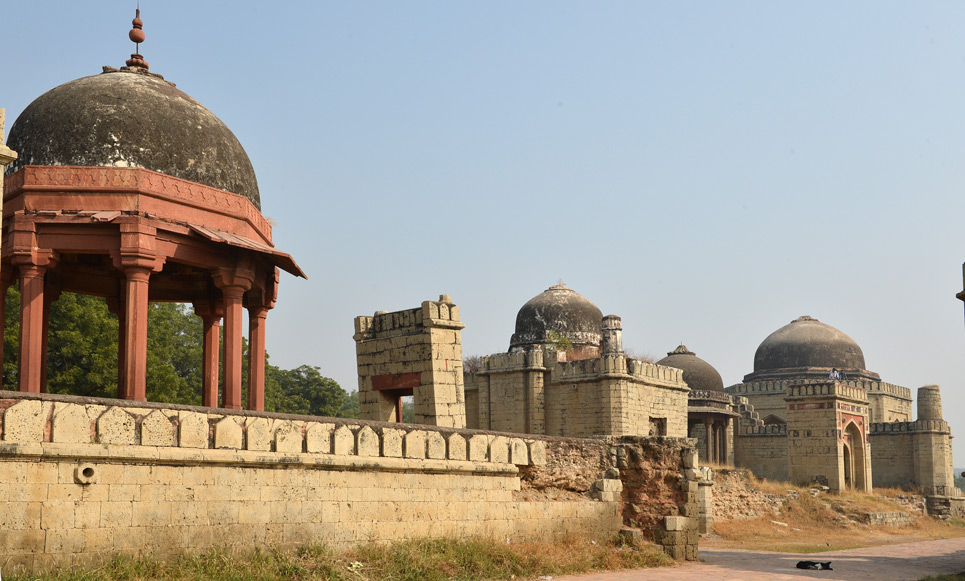
A group of seven tombs is located on the eastern side of town on the Jhajjar- Delhi road near the Bua ka Talab area. The tombs were built during the Mughal period between 1593 and 1630. Together they constitute a unique style. It will be more appropriate to call them graveyards. Each tomb stands on a raised platform, approached by a flight of steps. Each tomb also has a mosque or Idgah attached. A few of these also have chhatris or cupolas in the courtyard. Almost all of these tombs bear inscriptions providing valuable information. Another of their characteristic features is the presence of medallions in spandrels of arches. Only one of these has painted decoration. The material used for their constructions is invariably, what is locally called bichhwa kankar. Red sandstone was used only for decorative purpose. Most of the tomb-stones have been upturned and disturbed by treasure-seeking people who believed that untold wealth lay hidden under these. The earliest tomb has an inscription on its doorway, according to which Mian Raib, son of Pyara, built this tomb in Ramzan, 1002/1593-94 A. D. in the town of Jhajjar purnur (full of light) (Ulus. 33 & 34). In the courtyard there are two grave-stones.
The first bears an Arabic inscription on it. At its feet is a Persian inscription meaning that “everyone who has come into the world has to depart’’. The second tomb, according to an inscription, is that of Hasan Shaheed who was killed during the reign of Jahangir in 1035 A. H./1625-26 A. D. The gateway of the mosque in the third tomb enclosure bears an inscription in six verses in Persian which tells us that it is the tomb of Ismail, son of Raib, who founded the mosque in 1020 A.H./16H A.D?4 This enclosure also has an open octagonal cupola, just like that in the first one. The fourth is an octagonal building and not square, as Rodgers puts it Each side of its exterior measures 5.1 m. whereas the interior is a 6.4 m. square. The structure is covered with a dome, its soffit bearing the traces of painted designs. The rest of the interior was also adorned with geometrical and floral patterns painted in yellow ochre, green and red, the traces of which arc still extant. In the courtyard is an open cupola having octagonal pillars. At the rear is an Idgah. Red sand stone has not been used in this tomb at all. There is no inscription on it. The mosque of the fifth tomb (Illus. 35) bears an inscription on the central arch which gives out that in the reign of Shah Jahan, in the year 1039 A.H./ 1629-30 A.D., Kalal Khan built this high mosque. This man is said to have been a mace-bearer of Jahangir. The sixth and the seventh tombs consist merely of western walls without any mosque or cupola. Nor is there any historical inscription thereon. It seems that the men buried in these tombs were merely local celebrities. To Read More Visit This Book Link https://www.mughallibrary.com/ebooks2020/Mughal-Monuments-in-the-Punjab-and-Haryana Mughal Library